1. Executive Summary: The October 2026 Discovery
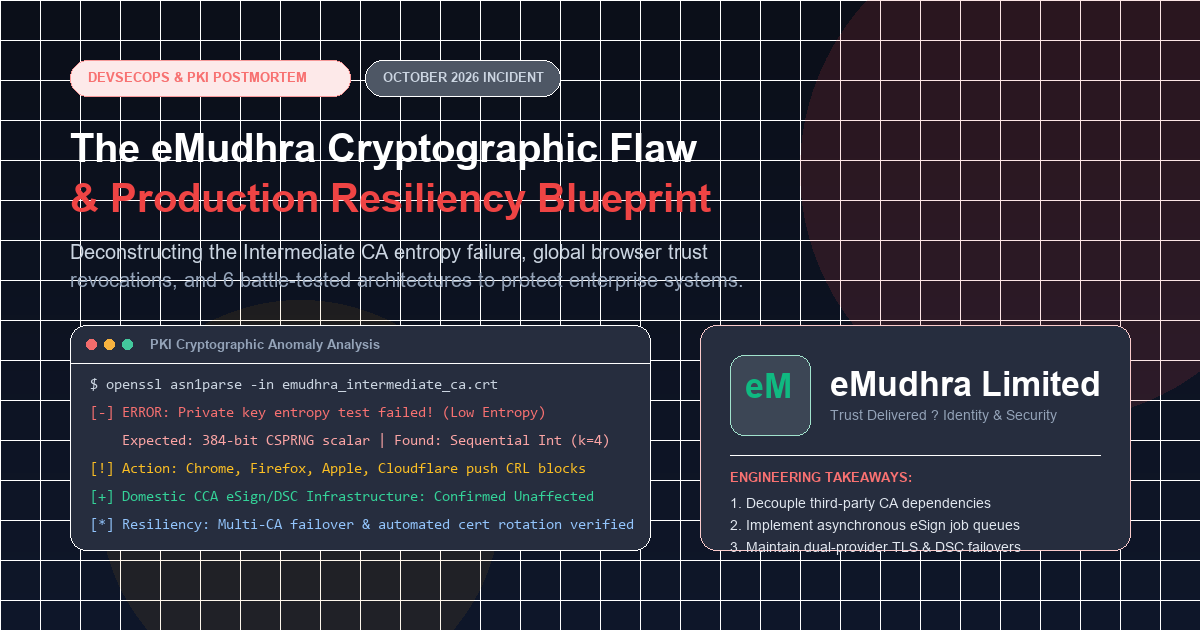
On October 17, 2026, the cybersecurity and public-key infrastructure (PKI) ecosystem was shaken by an alarming disclosure: an independent security researcher uncovered that private keys associated with eight intermediate Certificate Authorities (CAs) operated by eMudhra — generated during an official key generation ceremony on April 30, 2025 — suffered from a catastrophic cryptographic flaw.
Rather than being seeded with 384-bit cryptographically secure pseudorandom scalars (CSPRNG), the private keys were generated with
critically deficient entropy. In one astonishing instance, the private key of an intermediate CA was discovered to be simply the integer 4.
This meant anyone with knowledge of the public key could compute the private key in sub-second CPU time, theoretically allowing an attacker
to forge TLS certificates or code-signing signatures trusted by every major operating system on Earth.
2. Technical Anatomy of the Cryptographic Vulnerability
To understand how a private key equaled 4, we must examine elliptic curve cryptography (ECC) over NIST curves (such as P-384 / secp384r1):
- Normal ECC Key Generation: The private key d must be chosen uniformly at random from the range
[1, n-1], where n is the large prime order of the curve base point G. For P-384, this requires a 384-bit true random number. - The Entropy Collapse: Due to a software configuration script misconfiguration during the key creation pipeline, the CSPRNG seeding routine failed silently and defaulted to sequential small integer counter values.
- Trivial Discrete Logarithm Attack: Calculating the private key d from a public key Q = d × G is normally computationally infeasible (the Elliptic Curve Discrete Logarithm Problem). But when d is a single-digit integer like 4, Q is simply G + G + G + G. Any standard OpenSSL command or Python scalar script could deduce the private key instantly.
3. Global Browser & Infrastructure Response
Between October 17 and October 20, 2026, the global internet trust infrastructure mobilized in an emergency cadence:
- Google Chrome & Android: Pushed an emergency component update blocking the compromised intermediate serial numbers and disabling root trust chains.
- Mozilla Firefox: Updated OneCRL to instantly mark the eight intermediate certificates as revoked across all desktop and mobile installations.
- Microsoft & Apple: Updated Windows Certificate Trust Lists (CTL) and macOS/iOS trust stores.
- Cloudflare & AWS: Ingested certificate blacklists across their edge reverse proxies and API gateways to block any forged TLS handshakes.
- eMudhra's Strategic Pivot: Citing disproportionate scrutiny over an international website TLS business representing roughly 1% of total revenue, eMudhra announced its voluntary exit from the global SSL/TLS public certificate market to focus entirely on enterprise PKI and domestic digital identity.
4. The Indian Domestic CCA & eSign Distinction
A critical point of confusion during the incident was whether Indian domestic Digital Signature Certificates (DSC) and Aadhaar-based eSign services were compromised.
They were completely unaffected. Both India’s Computer Emergency Response Team (CERT-In Advisory CIAD-2026-0050) and the Ministry of Electronics and Information Technology (MeitY) confirmed:
- eMudhra's domestic Indian CA operations operate under the statutory regulation of the Controller of Certifying Authorities (CCA).
- These domestic operations reside on physically and logically isolated, air-gapped Hardware Security Modules (HSMs) governed by independent Indian Root CAs.
- The affected intermediate CAs were strictly tied to the international WebTrust / CA/Browser Forum public TLS hierarchy.
5. Production Engineering Blueprint: 6 Ways to Prevent Upstream PKI Outages
For enterprise software engineers, CTOs, and platform architects, this incident underscores a crucial reality: no third-party infrastructure provider is infallible. At CogFocus®, we architect enterprise applications to survive upstream certificate disruptions without taking down production systems:
1. Multi-CA Dynamic ACME Failover
Never hardcode a single Certificate Authority in your production automation. In Kubernetes and Nginx reverse proxies, configure dual ACME issuers:
# Example Cert-Manager Dual Issuer Hierarchy
apiVersion: cert-manager.io/v1
kind: ClusterIssuer
metadata:
  name: letsencrypt-primary
spec:
  acme:
    server: https://acme-v02.api.letsencrypt.org/directory
---
apiVersion: cert-manager.io/v1
kind: ClusterIssuer
metadata:
  name: zerossl-fallback
spec:
  acme:
    server: https://acme.zerossl.com/v2/DV90
2. Decoupled Asynchronous eSign & DSC Job Queues
When integrating third-party digital signature or eSign providers (such as eMudhra, Protean, or NSDL), never execute signature generation synchronously in web request threads. If the third-party API stalls or its CRL verification hangs, your web workers will exhaust connection pools:
- Dispatch document signing jobs into an asynchronous message queue (e.g. Celery + Redis or NATS JetStream).
- Implement an automated circuit breaker (e.g.
pybreaker) that trips to a fallback queuing state after 3 consecutive signing timeouts. - Notify end users asynchronously via webhooks or WebSockets once the digital signature batch is completed.
3. OCSP Stapling with Graceful Fallback in Nginx
When Certificate Authorities undergo emergency revocations, OCSP (Online Certificate Status Protocol) servers face millions of verification queries per second. If your web server queries OCSP synchronously on each TLS handshake, visitors experience severe latency:
# Production Nginx Resilient OCSP Stapling
ssl_stapling on;
ssl_stapling_verify on;
ssl_trusted_certificate /etc/ssl/certs/fullchain.pem;
resolver 1.1.1.1 8.8.8.8 valid=300s ipv6=off;
resolver_timeout 5s;
4. Pre-Commit Entropy Verification in Key Ceremonies
If your organization generates internal keys, self-signed certificates, or client-side mTLS tokens, integrate automated entropy validation scripts:
- Run the DIEHARDER and NIST SP 800-22 statistical test suites on all output scalars before packaging into PEM files.
- Enforce strict bit-length checks (e.g. assert
key.bit_length() == 384).
5. Synthetic Canary Certificate Revocation Testing
In your staging environments, simulate third-party certificate revocations by injecting mocked CRL lists into testing reverse proxies. Verify whether your mobile apps and web frontends gracefully display diagnostic connection guidance rather than crashing with unhandled SSL exceptions.
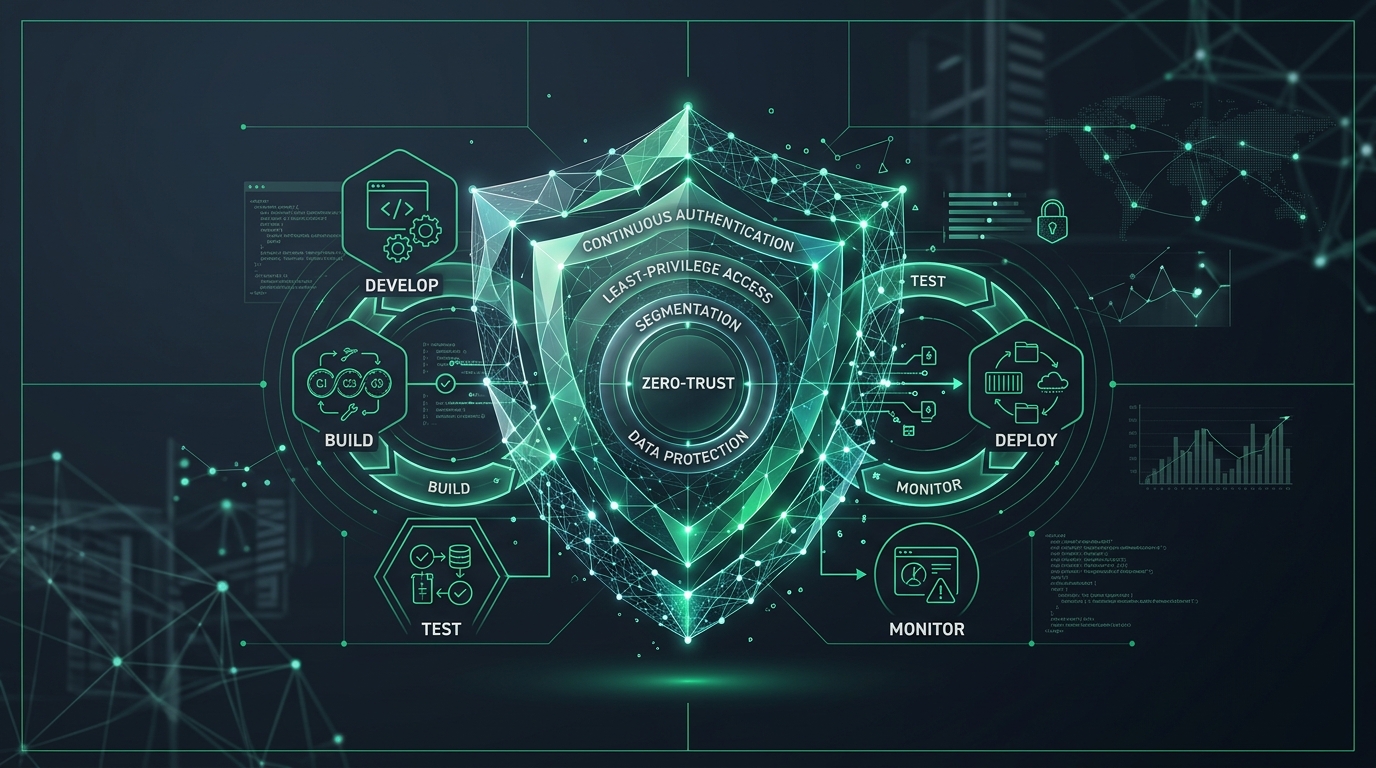
6. Zero-Trust Sovereign Internal mTLS
For inter-service communication between backend microservices, databases, and message brokers, never use public CAs. Deploy a sovereign internal PKI engine (such as HashiCorp Vault or SPIFFE/SPIRE) so external public web trust revocations have zero impact on internal transaction processing.
Conclusion: The Value of Sovereign Engineering
The eMudhra October 2026 incident is a powerful reminder that security is not a checkbox or an audit certificate — it is continuous architectural discipline. By implementing decoupled asynchronous integrations, dual-issuer failovers, and resilient reverse proxy configs, enterprise platforms remain online and secure regardless of upstream industry turbulence.